
Why Multi-Factor Authentication (MFA) is Crucial for Business Cybersecurity in 2025
1. Introduction
As businesses continue to embrace remote and hybrid work models, cyber threats are evolving at an alarming rate. In this landscape, relying solely on passwords to protect sensitive data is no longer sufficient.
Enter Multi-Factor Authentication (MFA) — a simple yet powerful security measure that is now essential for any modern business aiming to safeguard its digital assets.
This guide will walk you through the importance of MFA, how it works, and why it’s become a non-negotiable part of business cybersecurity in 2025.
2. What is Multi-Factor Authentication (MFA)?
Multi-Factor Authentication (MFA) is a security process that requires users to provide two or more verification factors to gain access to a resource such as an application, online account, or VPN.
The three categories of MFA factors are:
Something you know: a password or PIN
Something you have: a smartphone, hardware token, or access card
Something you are: biometrics like fingerprints or facial recognition
Example: Logging into your email account with a password (something you know) and a code sent to your phone (something you have).
Read the Microsoft Security Blog for more information.
3.Why Passwords Alone Are Not Enough
Passwords can be easily compromised through phishing attacks, brute force methods, or social engineering. According to the Verizon Data Breach Investigations Report, over 80% of hacking-related breaches involve weak or stolen passwords.
Even with complex password requirements, users tend to recycle passwords across multiple accounts, increasing vulnerability.
MFA adds an extra layer of protection, making it significantly harder for cybercriminals to breach your systems.
4. Key Benefits of MFA for Businesses
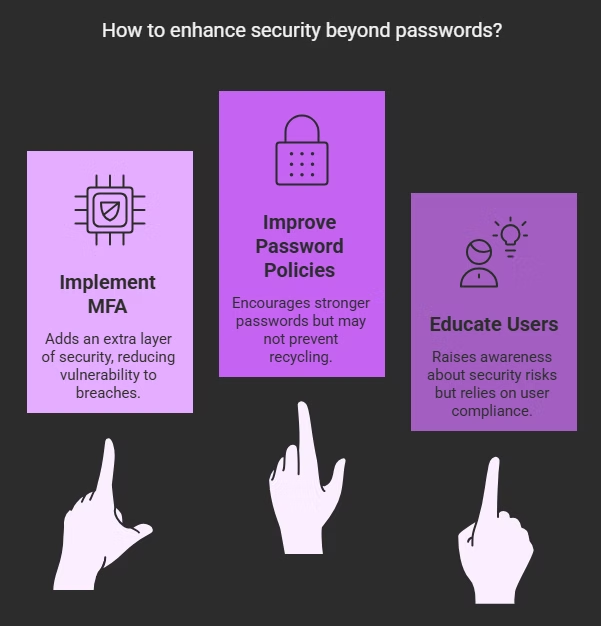
Enhanced Security: By requiring multiple forms of verification, MFA drastically reduces the likelihood of unauthorized access.
Regulatory Compliance: Helps businesses comply with standards like GDPR, HIPAA, and PCI-DSS.
Customer Trust: Demonstrates a proactive approach to security, improving brand reputation.
Reduced Fraud and Phishing Risk: MFA stops most phishing attacks even if credentials are compromised.
Implementing MFA is a key step in following cybersecurity best practices for businesses.
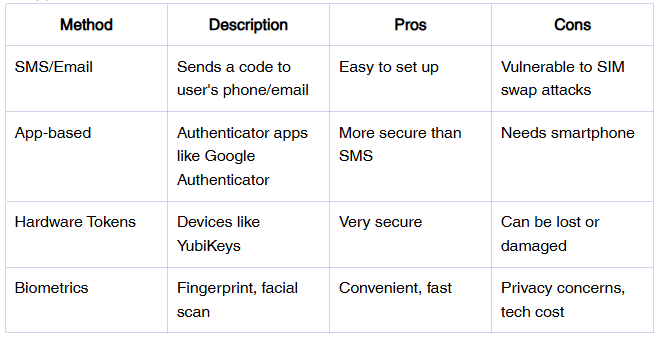
5. Types of MFA Methods for Businesses
6. Use Cases: Where MFA Adds the Most Value
Internal Systems: Securing access to sensitive tools like CRMs, HR platforms, or cloud storage
Remote Work: Ensuring only verified employees can access the network through VPNs
Learn more about How to set up Secure VPNs.
Financial Operations: Protecting approvals, transactions, and sensitive data
Third-Party Access: Limiting vendor access to internal resources
7. How to Implement MFA in Your Organization
Assess Your Current Security Infrastructure
Choose the Right MFA Solution (based on employee workflow and tools)
Pilot with a Small Team before full rollout
Train Employees on MFA use and importance
Monitor and Optimize for user experience and security effectiveness
8. Common Concerns and Misconceptions
“MFA slows down productivity”: Modern tools integrate seamlessly and add just seconds to login time.
“It’s too expensive”: Many affordable or even free MFA tools exist for SMBs.
“My team won’t use it”: Proper onboarding and education can drive adoption quickly.
9. Expert Opinions & Case Studies
“After implementing MFA across our organization, we saw a 90% reduction in phishing-related incidents.” — CTO, Mid-sized IT Firm
Case Study: A healthcare company deployed MFA and prevented a credential-stuffing attack that could have exposed patient records, saving them potential fines and reputation damage.
10. The Future of Authentication: MFA and Beyond
Password-less Authentication: Using biometrics or hardware tokens alone
Behavioral Biometrics: Monitoring user behavior for anomalies
AI and Adaptive Authentication: Real-time risk assessment for login attempts
MFA is just the beginning. Staying ahead of threats means adapting to new authentication methods.
Read the CISA tips on secure data for more information.
11. Conclusion
Multi-Factor Authentication is no longer just a “nice-to-have” — it’s a necessity.
From improved data security to regulatory compliance and increased customer trust, MFA is an easy win in your cybersecurity strategy.
Need help implementing MFA? Talk to our IT security experts and start protecting your business today.
FAQ About Multi Factor Authentication
Q: What are the disadvantages of MFA? A: Minor user inconvenience and implementation costs, but benefits far outweigh them.
Q: Can MFA be hacked? A: While rare, advanced attackers may bypass MFA, which is why layered security is key.
Q: How does MFA improve cybersecurity? A: It blocks unauthorized access even when passwords are compromised.